Anthropic IPO Roadshow: Valuation Cut, SMB Guide
Anthropic’s IPO roadshow kicks off this week, and the number everyone’s watching has already shrunk. As recently as the S-1 filing two weeks ago, Anthropic was targeting a valuation of up to $2 trillion — which would have made it the largest IPO in history. Now, per Bloomberg, investors are talking about $1.2 trillion to $1.3 trillion. A punishing post-election selloff in AI stocks did most of that damage. For small businesses that run on Claude, the pricing drama matters less than what comes after the listing. Here’s what actually changes for you.
What’s happening this week
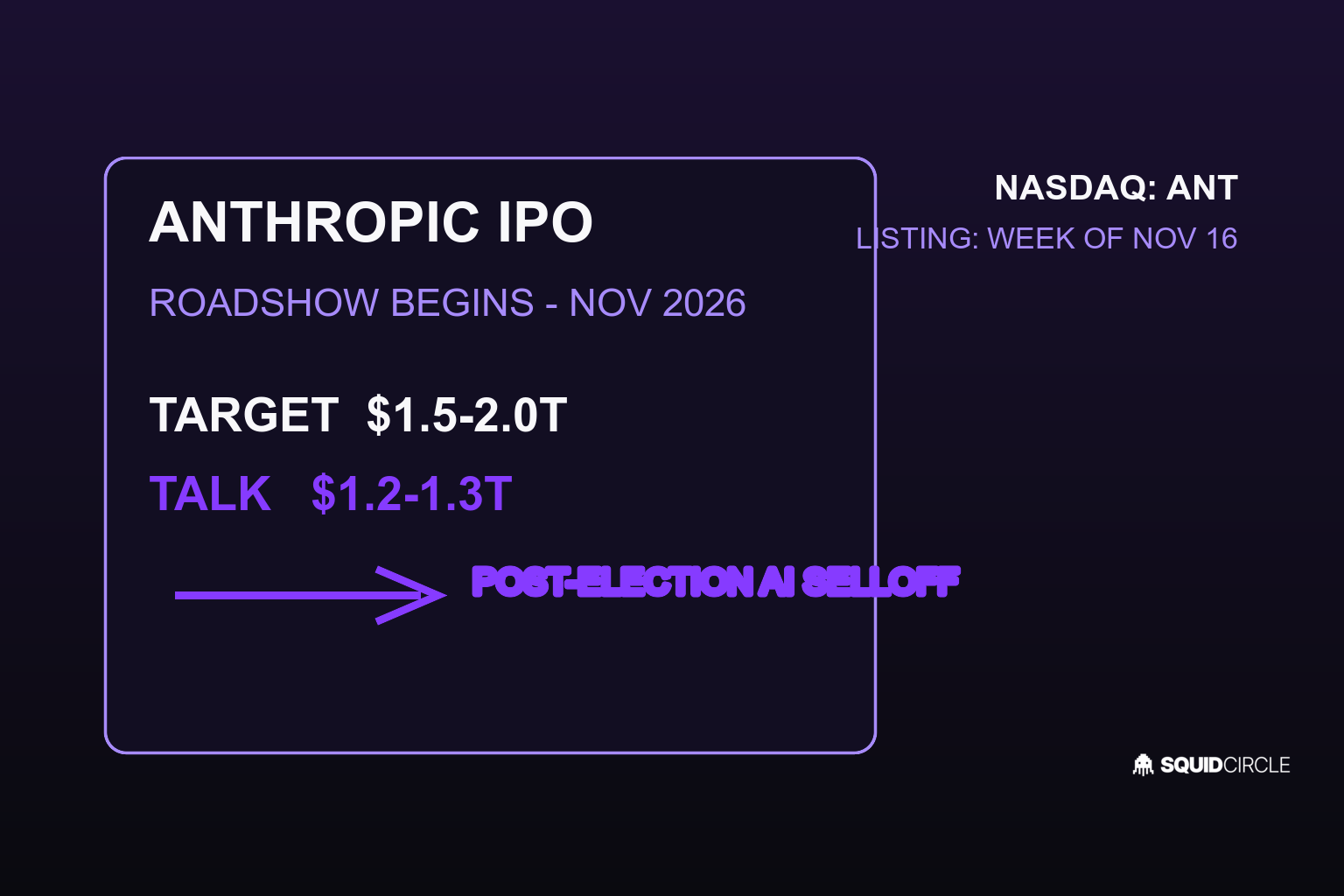
Anthropic filed its S-1 on October 26, disclosing $16.3 billion in first-half 2026 revenue — 14x the same period a year earlier — alongside an $80.7 billion net loss driven largely by convertible-bond accounting. Formal marketing to investors starts now, with a Nasdaq debut under ticker ANT targeted for the week of November 16. Goldman Sachs and Morgan Stanley are leading. The raise could top $60 billion, which would make it one of the largest IPOs ever.
The valuation talk is the story investors care about: $2 trillion hoped, $1.5 trillion whispered, $1.2–1.3 trillion now on the table. That’s a rough headline. But a 20–40% haircut on a private-market number is normal when public markets get a vote — and it says nothing about the health of the business underneath. Revenue growing 14x year over year is the part that matters.
Why a smaller valuation doesn’t change your calculus
If you use Claude — for customer support drafts, document analysis, agents, or anything else — the instinct when a vendor’s IPO stumbles is to ask “should I be worried?” Flip the question. Here’s what a listing actually does for you:
Quarterly transparency. Once Anthropic is public, you get revenue, margins, customer concentration, and cloud-dependency figures every 90 days. Today you’re pricing a critical vendor based on press reports. After the listing, you’re pricing it based on audited numbers. That makes budget planning easier, not harder.
Financial backstop. A public listing with a multi-billion-dollar raise means Anthropic’s balance sheet gets a permanent market to refill from. The extinction risk for a vendor you depend on goes down, not up, when it’s public — even at a lower valuation.
Pricing discipline. We’ve already flagged the trend of AI prices moving up as the market consolidates. Public companies answer to shareholders quarterly, and price increases are the fastest lever. Watch the first two earnings calls after the listing for pricing commentary — that’s when you’ll learn whether cheap Claude tiers survive.
The real risks worth tracking
None of them are the valuation. The risks we flagged in our S-1 breakdown still stand: heavy dependence on cloud partners for compute, a governance structure that keeps control with founders and a trust rather than public shareholders, and a cost base that grows as fast as revenue. The quarterly filings will now show, in numbers, whether those risks are shrinking.
There’s also the concentration angle. Anthropic, OpenAI, and SpaceX are all sucking capital out of the same market in a historically crowded listing window. If AI stocks stay weak, expect more valuation cuts like this one — and expect the labs to look harder at enterprise pricing to defend their public numbers. Your budget is where that pressure lands.
What to do this month
- Nothing drastic. A roadshow and a valuation cut are not stability signals for a vendor whose product works for you. Keep building on Claude if it’s earning its keep.
- Pin your exposure. List which workflows depend on Claude models specifically, so a future price change is a spreadsheet decision instead of a scramble. Cheap high-volume tiers like Haiku 5.5 are exactly the kind of pricing that public-market pressure could touch first.
- Calendar the earnings calls. The first two quarterly reports after the ANT listing will tell you more about your AI costs for 2027 than any analyst note. Listen for pricing, margins, and enterprise revenue.
- Diversify where it’s cheap to do so. If switching a workflow between models takes minutes, keep that flexibility. If it takes weeks, that’s vendor lock-in you’re choosing — do it consciously.
The bottom line
Anthropic will likely go public in the next two weeks at a valuation far below its wildest hopes. That’s a story about private-market hype meeting public-market math. For your business, the listing is good news: a core AI vendor gets more capital, more transparency, and quarterly accountability. The thing to watch isn’t the ticker on day one — it’s the pricing commentary on the calls that follow.
If you want help mapping which of your workflows are exposed to which AI vendor — and building swaps in before prices move — that’s what we do at SquidCircle. Start at squidcircle.com/squidbot.