Gemini Flash Prices Double Jan 1: SMB Budget Guide
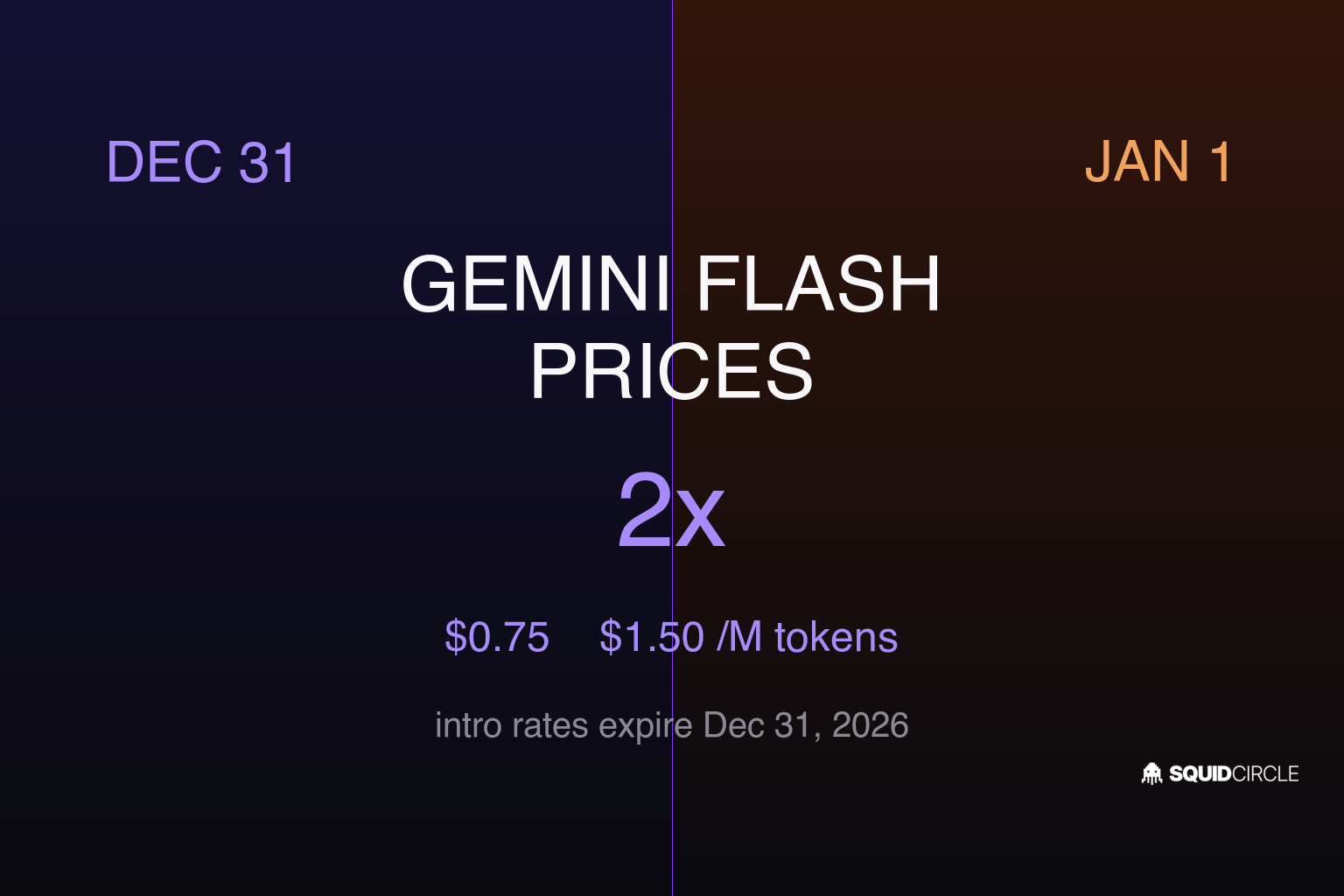
Google’s cheapest AI models are about to get a lot less cheap. If your business runs anything on the Gemini API — chatbots, lead-response automation, content pipelines — your bill is scheduled to double on January 1, 2027.
This isn’t a rumor. It’s a footnote in Google’s own pricing tables: the introductory rates on Gemini 3.8 Flash (and 3.6 and 3.7 Flash) expire December 31, 2026. Starting January 1, standard API pricing goes from $0.75 per million input tokens to $1.50, and from $3.75 per million output tokens to $7.50. Batch, flex, priority, and caching rates all double on the same day.
Here’s what that actually means for a small business, and what to do in the next two months.
What’s doubling, exactly
The Gemini Flash line is Google’s budget tier — the model family most automation vendors and agencies build on when cost matters more than raw intelligence. If you read our piece on cheap high-volume AI automation, Flash is Google’s answer to that same “workhorse” category. The current introductory rates:
- Input: $0.75 per million tokens through Dec 31, 2026; $1.50 from Jan 1, 2027
- Output (including “thinking” tokens): $3.75 per million through Dec 31; $7.50 from Jan 1
- Batch/flex: currently half the standard rate; doubles alongside it
- Cached input: $0.075 per million now; $0.15 after
If your token usage stays flat, your bill doubles. There’s no usage threshold, no grandfathering clause, and no opt-in — the date simply arrives.
Why the hidden cost is worse than the sticker
The trap most businesses fall into with reasoning models isn’t the listed price. It’s the invisible output. Gemini 3.8 Flash “thinks” before answering, and those thinking tokens are billed as output — at the expensive rate. Independent benchmarks put a typical agentic task (30K input tokens, 800 visible tokens, 6,000 thinking tokens at the default reasoning level) at roughly $0.58 per task at today’s rates.
Double that in January, and a workflow handling 500 tasks a day goes from ~$87/day to ~$174/day. That’s the difference between a rounding error and a real line item in your P&L.
What to do before December 31
1. Find out if you’re exposed. If you built automations yourself, check your Google AI Studio or Vertex AI billing dashboard for token volume by model. If an agency or vendor built them, ask one question: “Which Gemini model, and how many tokens per month?” Anything answering “Flash” is on the doubling list.
2. Test the thinking-level settings now. Reasoning effort is usually configurable. Low thinking levels run materially cheaper per task — some benchmarks show low at roughly $0.24 per task versus $0.58 at high. Run your own tests at each level, keep the lowest one that still passes your quality bar, and lock it in so it can’t drift.
3. Build the batch and cache paths. Batch jobs run at half the standard rate, and cached input is 90% cheaper than fresh input. Anything in your stack that doesn’t need a real-time answer — report generation, content reprocessing, enrichment jobs — should be moved to batch before the deadline. The relative discounts survive the doubling; the absolute bill still doubles if you stay on interactive standard calls for everything.
4. Model two halves of the year. If you’re budgeting 2027 AI spend, don’t extrapolate Q4. Run January–June at double rates and see what your automations actually cost at steady state. That number, not the promo rate, is the real price.
5. Price-check the alternatives — but read the fine print. Competing small models exist, and some are cheaper even after Google’s rates double. But before you migrate anything, check whether their launch pricing is also introductory. Promo rates that expire quietly are becoming an industry pattern, and Google’s footnote is the clearest example yet.
The bigger lesson
Introductory AI pricing is a marketing instrument. Vendors launch fast, cheap models to win developers, then normalize prices upward once workflows depend on them. We covered a cousin of this problem in Google’s Gemini platform shake-ups — the platform you build on can shift under you. The businesses that get hurt aren’t the ones using AI; they’re the ones who baked a promotional rate into an automation without knowing it had an expiry date.
Every AI line item in your budget should carry two numbers: what it costs today, and what it costs at list price. If you don’t know the second number, you don’t actually know the first one’s meaning.
Bottom line
You have roughly two months of promotional pricing left on the Gemini Flash family. Use them to measure your real token volume, tune your reasoning settings, batch what can wait, and re-budget at the January rates. The doubling is predictable. Getting surprised by it isn’t.
If you want a second pair of eyes on your AI stack before prices shift, SquidBot audits what you’re running, what it actually costs at list price, and where the quiet expiring discounts are hiding.