Businesses in ChatGPT Just Went Live: Claim Yours Before Competitors Do
ChatGPT Is Now a Business Directory. Act Accordingly.
Yesterday OpenAI flipped the switch on Businesses in ChatGPT — a beta that lets any business claim its organization inside ChatGPT, control the information the model shares about it, and see aggregated insights into how 1.2 billion weekly users actually engage with it. If that sounds like Google Business Profile for the AI era, you’re not far off. The difference: this one launched yesterday, and most of your competitors haven’t claimed theirs yet.
We spent the morning walking through the announcement, the Business Hub, and the Business Agent eligibility rules, because this is exactly the kind of shift that matters more for a ten-person shop than for an enterprise with a fifty-person SEO team. Here’s what’s actually live, what’s still gated, and what to do this week.
What Launched: Three Pieces
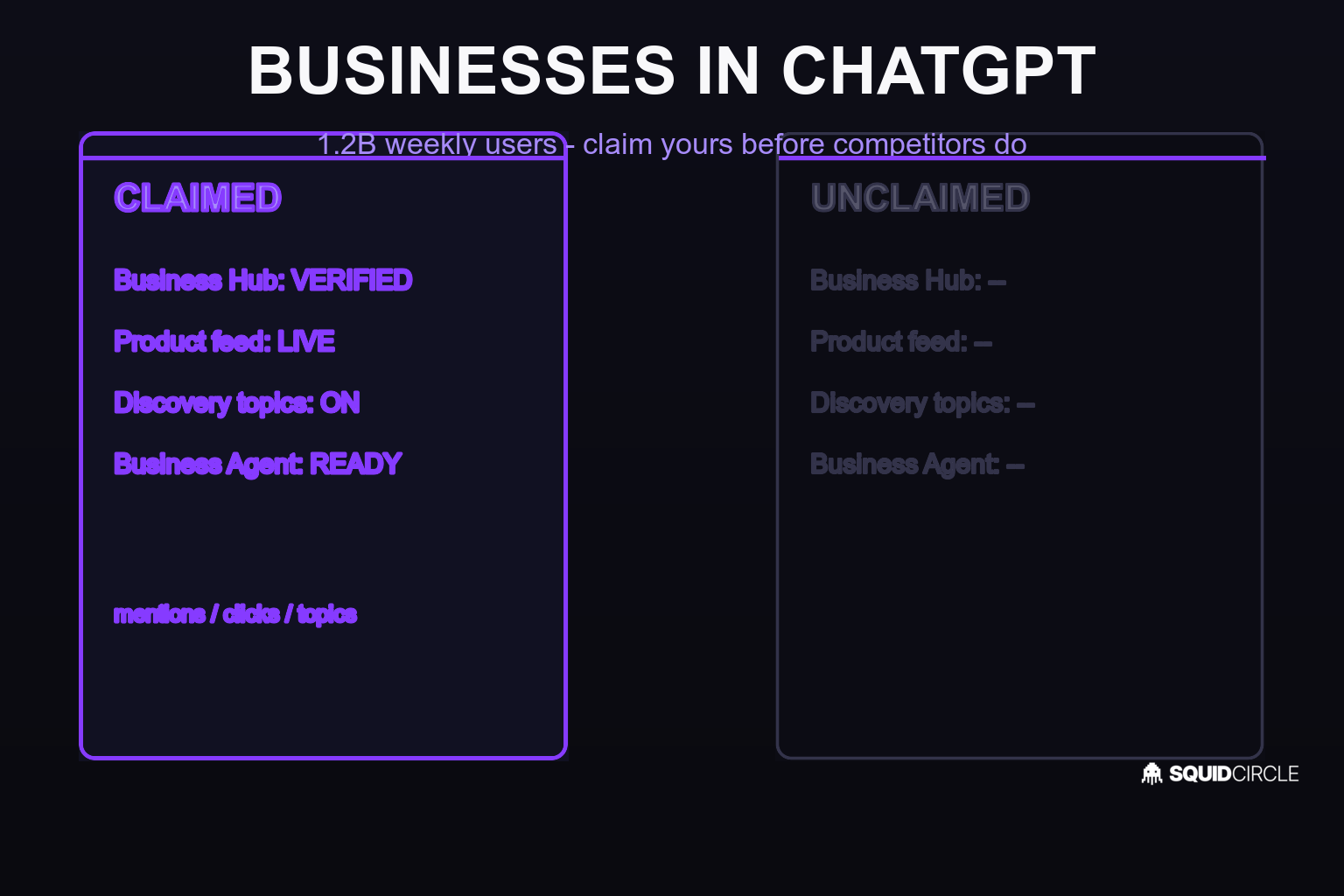
1. Claim and verify your business. Through the new Business Hub, any eligible business located where ChatGPT is available can claim its organization. Once verified, you can update key details and add self-service product feeds with pricing and availability. Shopify merchants get the fast lane — you can connect your store directly from Business Hub or the Shopify admin, and eligible products are already flowing into ChatGPT through Shopify Catalog. Existing OpenAI Enterprise customers and advertisers can claim through their rep.
2. Engagement insights. Business Hub shows aggregated metrics: how many mentions your business receives, how many website clicks those mentions drive, and “discovery topics” — the common themes across conversations where your site gets cited. That last one is quietly the most valuable thing here. It’s free, aggregated voice-of-customer data telling you what people are actually asking ChatGPT about when your name comes up. OpenAI is gating everything behind privacy thresholds, so you won’t see individual conversations — just patterns once volume is high enough.
3. Business Agents. This is the bigger strategic play. Eligible businesses can build and launch a Business Agent — an AI agent that appears on your ChatGPT profile and can answer questions, compare product options, and help people figure out if your offering fits their needs. When your business shows up in a model response, users can click through to your profile and start a conversation with your agent. Those conversations are clearly labeled and separate from ChatGPT’s independent answers. Eligibility right now: US-based ecommerce and online service businesses only.
Why This Matters for Small Businesses Specifically
We’ve been tracking the collision between AI assistants and business discovery all year — from ChatGPT Ads crossing a billion in revenue to Meta and Apple racing to open their AI surfaces to businesses. Businesses in ChatGPT is the connective tissue: the claim-and-verify layer that makes all of it work. OpenAI has already said businesses can sponsor their Business Agent and use it as the destination for ChatGPT Ads, with placements clearly labeled.
The practical read: ChatGPT is becoming a place where decisions get made — what to buy, who to hire, which service fits. If the model is citing your website with stale pricing or wrong hours, you now have a way to fix that at the source instead of waiting for the next crawl. And unlike the early days of opt-out standards for AI crawling, this is an opt-in channel where participation is the whole point.
Your This-Week Checklist
Claim your business in Business Hub. Verification is the gate for everything else. It costs nothing and takes minutes. Do it before your competitor with the same name in another state does.
Audit what ChatGPT currently says about you. Ask ChatGPT the questions a customer would: pricing, services, hours, comparisons against local competitors. Screenshot the answers. Whatever’s wrong is your priority fix in the profile — and on your website, since that’s still the model’s main source.
Get your product data feed-ready. Self-service feeds with pricing and availability are live. If you’re on Shopify, connect the catalog — structured, accurate product data is what turns a mention into a click.
Watch discovery topics for a week. Once insights populate, the discovery topics are free keyword research for the AI era. If people keep asking whether you do emergency calls and your site buries that answer, you’ve found your next content fix.
If you’re US ecommerce or online services, prototype a Business Agent. You don’t need to launch polished. Build one, test it with the questions from your discovery topics, and iterate. Early agents in a new channel have embarrassingly low competition.
What to Watch, Not Rush
This is a beta. Expect the eligibility categories, markets, and insight thresholds to shift. The businesses that win here won’t be the ones that launched the flashiest agent on day two — they’ll be the ones with clean, verified, structured information that AI assistants can trust, because that’s what every future feature gets built on top of. Claim the profile now, fix the data foundation, and treat the agent as your test lab.
If you want a hand setting up your ChatGPT business presence — claim, product feed, or a Business Agent that actually converts — that’s exactly what we build at SquidCircle. Talk to SquidBot and we’ll get you claimed and cited correctly.