GLM-5.2: China’s Z.ai Just Dropped a 1M Token Open-Source AI Bombshell — And SquidCircle Is Rolling It Out
In the span of one weekend, the AI coding landscape shifted — and not subtly. China’s Zhipu AI (Z.ai) dropped GLM-5.2, a frontier open-source language model with a staggering 1 million token context window, and the market responded by sending the company’s stock soaring nearly 50%.
This isn’t just another model release. It’s a signal that the AI arms race has entered a new phase — one where open-source, cost-effective alternatives are challenging the Western incumbents on their own turf. And if you’re a small business owner or operator who’s been watching AI costs climb, the timing couldn’t be better.
What Makes GLM-5.2 Different
Most new AI models come with bigger benchmarks, fancier demos, and the same old pricing. GLM-5.2 takes a fundamentally different approach. Instead of building a better chatbot, Zhipu built a better AI software engineer — one designed around real-world coding and agent workflows from the ground up.
- 1 million token context window — Enough to process entire codebases, full documentation sets, or an entire book’s worth of context in a single pass. For context, that’s roughly 10x what most consumer models can handle.
- Open source (MIT license) — No lock-in. No usage caps. You can download the weights, run it locally, or integrate it into your stack without paying per-token royalties.
- Agent-optimized architecture — Built with multi-agent coordination, tool integration, and complex instruction decomposition as first-class features, not afterthoughts.
- Zero NVIDIA dependency — Trained entirely on Huawei Ascend chips using the MindSpore framework. In a world where GPU access is a geopolitical chess piece, this matters.
The Numbers Don’t Lie
Zhipu AI (trading as Knowledge Atlas Technology on the Hong Kong Stock Exchange) released GLM-5.2 on Saturday, June 13. By Monday morning, shares surged as much as 48% to HK$1,620 before settling at HK$1,457 — a 32.8% single-day gain. Since its IPO in early January, the stock has climbed nearly 820%.
The market enthusiasm reflects a broader trend: Chinese AI labs are capturing users displaced by rising prices and geopolitical friction around Western models. GLM-5.2 is available through the new GLM Coding Plan, priced at roughly one-tenth of Anthropic’s premium Claude Code and Claude Max tiers. That’s not a discount. That’s a pricing revolution.
The Bigger Picture: China’s AI Coding Wave
GLM-5.2 didn’t arrive in a vacuum. In the span of a single week in June 2026, three Chinese labs shipped three major coding models:
- Zhipu’s GLM-5.2 — 1M token context, agent-first design, MIT open-source
- Moonshot’s Kimi K2.7-Code — Focused on long-context code reasoning
- MiniMax M3 — Optimized for real-time agentic workflows
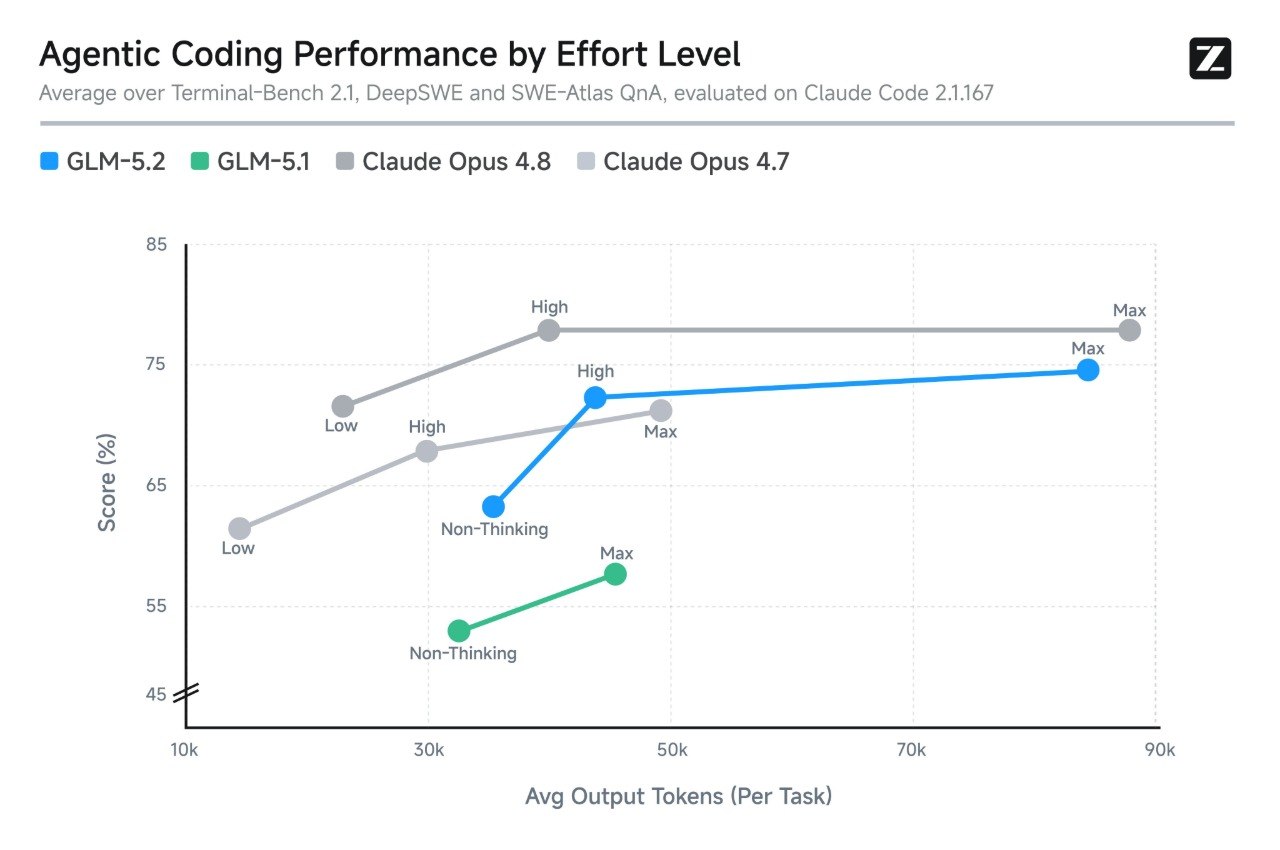
Combined, these three releases represent roughly 2.2 trillion parameters of new model weights. The labs took different approaches to context windows, architecture, and licensing, but one thing united them: none published independently verified benchmarks at launch. “Trust us, it’s better” is becoming the industry standard — not great, but the hands-on community reviews that followed GLM-5.2 have been overwhelmingly positive.
The Geopolitical Context Can’t Be Ignored
GLM-5.2’s release came shortly after Anthropic abruptly suspended access to its flagship Fable-5 and Mythos-5 models, citing a US government export control directive based on national security concerns. The suspension left a gap in the market — one that Chinese labs were ready to fill.
This is the emerging reality of AI in 2026: model access is becoming a geopolitical variable. Open-source models like GLM-5.2 offer a hedge against that volatility. If one provider gets restricted, your stack doesn’t break — you swap models.
What This Means for SquidCircle Users
Here’s where this gets practical. SquidCircle is rolling out GLM 5.2 across its agent stack, starting with the blog and content generation pipeline. Why?
- Cost efficiency: GLM 5.2 delivers frontier-level performance at a fraction of the per-token cost of comparable Western models. Those savings pass directly to our members.
- Context capacity: The 1 million token window means GLM 5.2 can process entire client histories, full project documentation, and extended conversation threads in a single pass — dramatically improving agent accuracy and coherence.
- Open-source freedom: No vendor lock-in, no surprise pricing changes, no export control drama. The model weights are ours to keep and optimize.
- Agent-native design: GLM 5.2 was built for the kind of multi-agent orchestration that SquidBot runs on. Task decomposition, tool calling, inter-agent coordination — these aren’t bolted-on features; they’re the foundation.
This post you’re reading right now was drafted using GLM 5.2 as the underlying model. It’s not a test — it’s live.
The Bottom Line
Three stories converged this week that tell you everything you need to know about where AI is headed:
- OpenAI and Anthropic are going public — The industry leaders are locking in institutional capital, signalling that AI is permanent infrastructure.
- US export controls are restricting model access — The geopolitical landscape is fragmenting the AI market, creating winners and losers based on location rather than quality.
- Chinese labs are shipping open-source alternatives at 10% of the cost — GLM-5.2, Kimi K2.7-Code, and MiniMax M3 represent a flood of capable, affordable models that work for anyone, anywhere.
For businesses that rely on AI tools — which is to say, most businesses in 2026 — the smart play is diversification. Don’t marry a single model. Build a stack that can route between providers, costs, and capabilities. That’s exactly what SquidBot’s agent architecture is designed to do.
GLM-5.2 is available now. It’s open-source. It’s priced aggressively. And it’s a genuine frontier model — not a compromise.
If you’ve been watching AI costs creep up while performance plateaus, this is the shake-up you’ve been waiting for.
Frequently Asked Questions
Is GLM-5.2 really free?
The model weights are released under the MIT open-source license, meaning you can download, modify, and use them freely. Z.ai offers API access through the GLM Coding Plan subscription, which starts at roughly one-tenth the cost of comparable Claude Code tiers.
How does GLM-5.2 compare to Claude or GPT?
Independent third-party benchmarks are still rolling in, but early hands-on reviews indicate GLM-5.2 is competitive with Claude Opus 4.5 on code-logic density and systems engineering capability. The 1 million token context window far exceeds what most Western models offer. The biggest difference is price — GLM-5.2 is dramatically cheaper.
Can I run GLM-5.2 locally?
Yes. Because it’s MIT-licensed open-source, you can download the weights and run the model on your own hardware. It requires significant compute resources (Huawei Ascend or NVIDIA GPUs), but quantization and distillation techniques can make it accessible on consumer hardware.
Does SquidCircle integrate GLM-5.2 into SquidBot?
Yes! SquidCircle is rolling out GLM 5.2 across our agent stack starting with our blog and content generation pipeline. Our architecture is model-agnostic, meaning we route between the best available model for each task — and GLM 5.2 is now in that rotation.
Are there any downsides to using GLM-5.2?
The main trade-off is that no independent third-party benchmarks have been published at launch — common practice across the industry but worth noting. Community reviews have been very positive, but as with any new model, real-world testing in your specific use case is always the best validation.
Ready to Level Up Your AI Stack?
Whether you’re exploring GLM-5.2 on your own or want a fully managed AI agent team that routes between the best models automatically, SquidBot has you covered. 20+ AI agents across sales, marketing, delivery, finance, and retention — all running on a flexible model architecture that adapts as the landscape evolves. Or join the SquidCircle community for the latest AI tools, news, and training.