Anthropic’s $2T IPO Filing: What SMBs Should Know
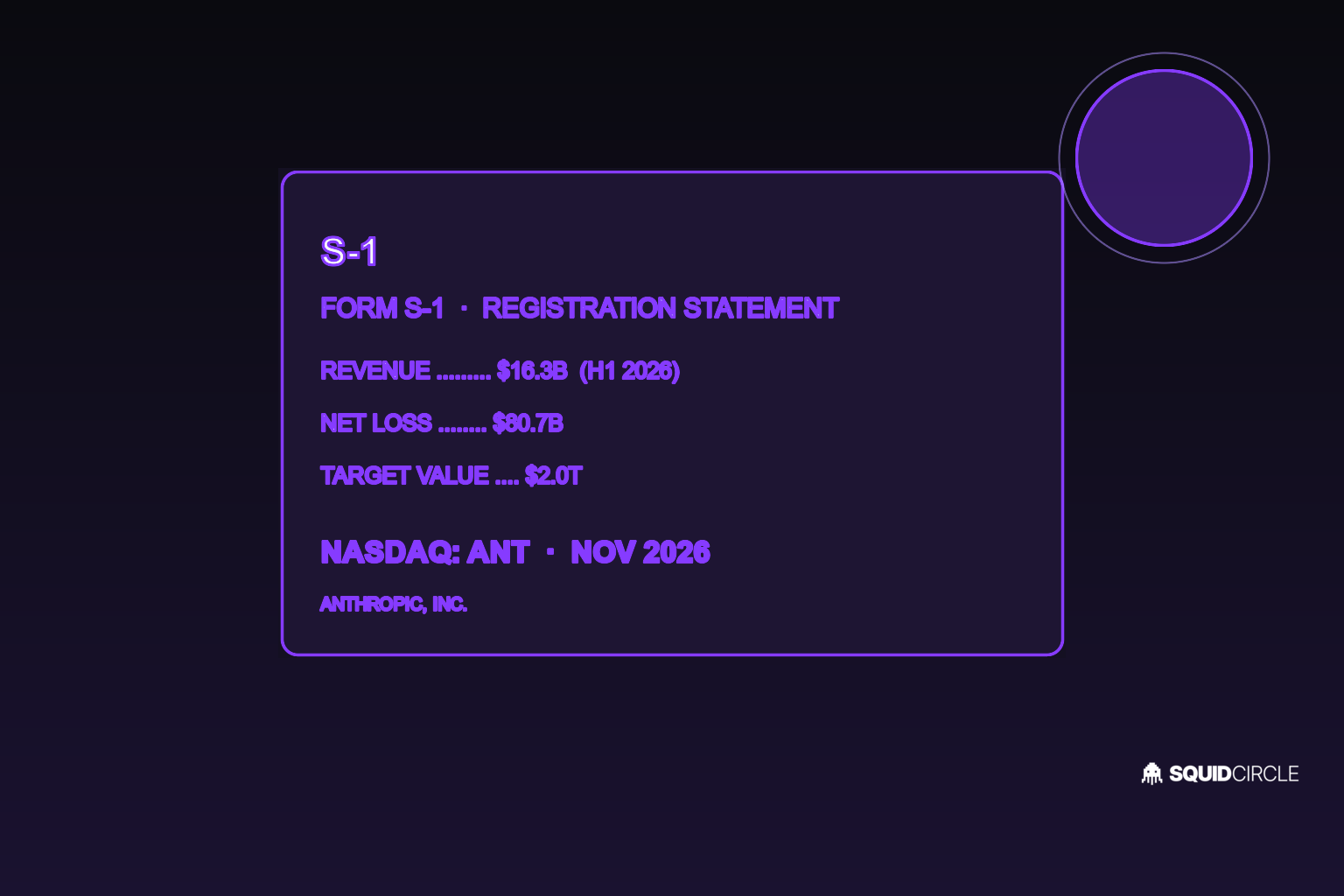
Anthropic filed its public S-1 on October 26, and if the bankers get their way, the company behind Claude will list on the Nasdaq under the ticker ANT before Thanksgiving — possibly as the largest IPO in history, targeting a valuation of up to $2 trillion.
Unless you’re planning to buy shares, you might be tempted to ignore IPO news. Don’t. That filing contains the most honest picture of AI economics anyone has ever published — including numbers the vendors would rather you didn’t do the math on. Here’s what small business owners should actually take away from it.
The numbers in the filing
Three figures matter:
- Revenue: ~$16.3 billion in the first half of 2026. That is explosive growth by any measure — Anthropic was a fraction of that a year ago.
- Net loss: $80.7 billion over the same period. Most of that is accounting noise from convertible bonds, but the underlying cash burn is still enormous.
- Valuation target: $1.5–2 trillion, which would instantly place Anthropic among the ten most valuable U.S. tech companies.
The gap between $16 billion in revenue and a $2 trillion price tag is the whole story. Investors aren’t buying what Anthropic earns today — they’re betting your business becomes completely dependent on Claude-shaped AI within the decade.
Why this matters if you run a small business
1. Your AI costs are being subsidized — for now
A company losing tens of billions of dollars while selling Claude access this cheap is subsidizing your operations. That’s great while it lasts. But public companies answer to shareholders quarterly, and the fastest path from an $80 billion loss to profitability is price discipline. Expect the bargain pricing era to slowly end — we’ve already seen the pattern with Gemini Flash doubling prices in January. Lock in annual plans where it makes sense.
2. Vendor concentration risk is now on the record
The S-1 itself flags Anthropic’s dependence on a handful of cloud providers (Amazon, Google, Microsoft) and chip suppliers like Broadcom. Translation: the entire stack — from silicon to the model you chat with — is one tightly coupled supply chain. If you build your entire operation on a single AI vendor, you inherit risks you can’t see or control. We learned this the hard way building our own agent workflows: the more an AI system can do, the more carefully you have to monitor it.
3. The slowdown language is real, and it’s in writing
The filing explicitly flags risks from AI causing harm — and CEO Dario Amodei has publicly called for slowing development of the most advanced models. When the riskiest thing about your product is disclosed in your own IPO paperwork, pay attention. For SMBs, this means capability jumps may come with more guardrails, more rate limits, and more changes to how existing automations behave. Budget for maintenance, not just setup.
4. IPO money means aggressive enterprise sales — and a widening gap
Post-IPO, Anthropic will be under immense pressure to grow revenue fast. That means enterprise features, enterprise pricing, and enterprise attention. Small businesses will keep access to the same underlying models, but the differentiated tooling will aim upmarket. The window where SMBs get frontier capabilities at commodity prices is exactly now — use it.
What to actually do this week
You don’t need to touch the stock. Do this instead:
- Audit your AI dependencies. List every workflow that would break if one vendor’s API changed or disappeared. Anything critical needs a fallback model configured.
- Lock in current pricing on tools you use daily, before public-market margin pressure arrives.
- Build while it’s cheap. The implementation gap between businesses using AI well and those ignoring it is widening. If you haven’t automated lead response, intake, or follow-up yet, this is the cheapest that capability will ever be.
The bottom line
Anthropic’s S-1 is a rare moment of transparency in an industry built on hype. It says: the growth is real, the losses are staggering, the dependencies are deep, and the people building this stuff think it needs to slow down. Small businesses that treat AI as powerful-but-impermanent infrastructure — rather than a utility that will always be there at today’s prices — will be fine either way.
If you want a team that builds on this stuff every day and turns it into working automations for your business, that’s exactly what we do at SquidCircle.