Nvidia’s $250 Billion Ohio Data Center: What the Biggest AI Infrastructure Deal Means for Small Business
Quick Summary
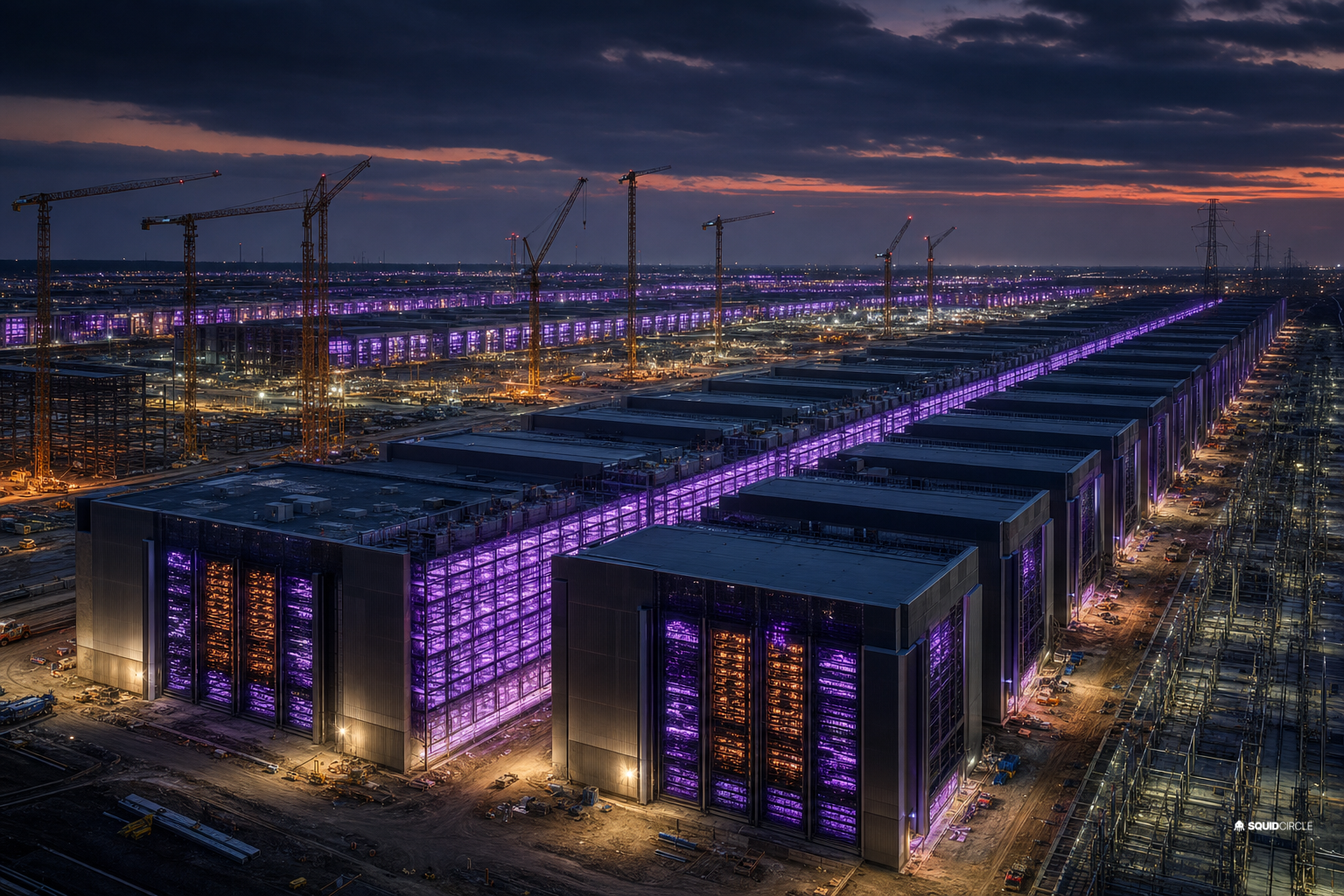
Nvidia is in talks to guarantee roughly $250 billion in financing for OpenAI as part of a massive data center project in southern Ohio that could ultimately cost more than $500 billion, according to a Wall Street Journal report published July 26, 2026. The 10-gigawatt campus — built on federal land at the former Portsmouth Gaseous Diffusion Plant in Piketon, Ohio — would be the largest AI data center ever constructed. For small businesses, this matters because it signals that AI infrastructure is scaling to utility-grade levels, which means cheaper, faster, and more capable AI tools heading your way over the next 3 to 5 years.
What Happened
On July 26, the Wall Street Journal reported that Nvidia is negotiating to provide approximately $250 billion in financial guarantees for OpenAI as part of a sprawling data center project in southern Ohio. Here is what we know from the reporting:
- The scale: The proposed 10-gigawatt data center campus could cost more than $500 billion to build, making it the largest AI infrastructure project announced to date. For context, that is more than the GDP of New Zealand.
- The power: SoftBank’s SB Energy is developing a 9.2-gigawatt natural gas power plant to fuel the campus. At the March groundbreaking, SoftBank CEO Masayoshi Son called it “bigger than any power plant in the world.”
- The financing structure: Nvidia would serve as a financial backstop for OpenAI’s 20-year lease. Nvidia is also reportedly discussing financing OpenAI’s chip purchases, which could total up to $350 billion.
- The power deal: The electricity for the project is controlled by the U.S. government and funded by Japan under a recent trade agreement. Commerce Secretary Howard Lutnick is involved in determining who receives access.
- Timeline: The first phase is expected to come online in 2028 with approximately 800 megawatts of capacity.
The deal would give OpenAI its first dedicated data center lease, reducing its reliance on cloud providers like Microsoft, Amazon, and Oracle. It also reflects OpenAI’s projected AI infrastructure spending of roughly $750 billion through 2030.
This is not happening in isolation. Separately, Apollo and Blackstone are financing a $35 billion AI capacity expansion for Anthropic using Broadcom chips, according to Reuters. The infrastructure arms race is fully underway.
Why It Matters for Small Businesses
You might be thinking: “A $500 billion data center in Ohio is interesting, but what does it have to do with my 12-person HVAC company?” Fair question. Here is the connective tissue.
Every major leap in AI capability is downstream of compute. More compute means larger models, faster inference, lower per-query costs, and new capabilities that were economically impossible the year before. When OpenAI builds a 10-gigawatt facility dedicated to AI workloads, the downstream effect is that the AI tools your business uses — whether that is an AI receptionist, a content generation pipeline, or a CRM enrichment agent — get meaningfully better and cheaper.
Think of it like the interstate highway system. When the U.S. invested in massive road infrastructure in the 1950s, the direct beneficiaries were construction companies and the federal government. But the indirect beneficiaries were every business that suddenly had cheaper, faster access to suppliers and customers. AI infrastructure is building the same kind of network effect today.
The SBE Council’s Digital State of Small Business 2026 survey found that 91% of small businesses using AI report higher revenue after adoption. That number climbs as AI infrastructure scales and the tools become more capable.
How Small Businesses Can Prepare
The businesses that win the next decade will not be the ones with the biggest AI budgets. They will be the ones that built AI into their operations early, while the cost curve was still bending downward. Here is what to do now:
1. Start Automating Repetitive Work Now
If you are still manually answering every lead inquiry, scheduling appointments by hand, or copy-pasting data between systems, you are burning hours that AI can handle today. AI workflow automation is no longer experimental — it is table stakes. The tools available right now are the worst they will ever be. They will only get better as the infrastructure behind them scales.
2. Consolidate Your AI Stack
One side effect of the AI boom is tool sprawl. Many small businesses end up paying for five different AI tools that overlap in functionality. AI stack fatigue is real, and it costs more than it saves. Audit your tools quarterly and consolidate around platforms that handle multiple functions.
3. Build AI Literacy Across Your Team
The infrastructure investment means AI capabilities will keep accelerating. Your team needs to be ready to adopt new tools as they arrive. This does not mean everyone needs to learn prompt engineering. It means building a culture where employees are comfortable using AI for daily tasks and are encouraged to experiment.
4. Get Your Data House in Order
AI is only as good as the data it can access. If your CRM is a mess, your email archives are unsearchable, and your customer data lives in scattered spreadsheets, even the most powerful AI in the world will struggle to help you. Start with a CRM cleanup and build from there.
The SquidCircle Perspective
At SquidCircle, we see the Nvidia-OpenAI Ohio deal as the clearest signal yet that AI is transitioning from a premium tool to foundational infrastructure. When Nvidia — a chip company — is willing to backstop $250 billion in financing, it tells you that the biggest players in the ecosystem are betting everything on AI becoming as ubiquitous as electricity.
For owner-operated businesses, the implication is clear. The cost of running a full-stack operations team — receptionist, scheduler, follow-up coordinator, content writer, CRM manager — is heading toward zero. Not because those functions become unnecessary, but because AI agents can handle them at a fraction of the cost.
We are already seeing this with our clients. AI agents that automate lead follow-up, book appointments, and onboard new clients without human intervention are not future technology. They are running right now, on infrastructure that this $500 billion deal will supercharge.
Want to see what AI agents can do for your business today? Explore SquidBot — purpose-built to run entire business functions for small businesses. Or join The Boardroom, our private community where operators share what is actually working.
FAQ
What is the Nvidia-OpenAI Ohio data center deal?
Nvidia is in talks to provide approximately $250 billion in financial guarantees for OpenAI as part of a proposed 10-gigawatt data center campus in Piketon, Ohio. The total project cost could exceed $500 billion, with the first phase expected online in 2028.
How does this affect small businesses?
Massive AI infrastructure investment drives down the cost of AI capabilities over time. The tools small businesses use — from AI chatbots to automated scheduling — become more powerful and affordable as compute scales. The downstream effect is better, cheaper, and faster AI services for everyone.
Why is Nvidia financing OpenAI’s data center?
Nvidia’s business model depends on continued demand for its GPUs. By helping OpenAI secure financing for a massive data center, Nvidia ensures long-term demand for its chips while positioning itself as the central infrastructure provider of the AI economy. The deal also includes discussions about financing OpenAI’s chip purchases, which could total $350 billion.
Should small businesses invest in AI now or wait for costs to drop?
Start now. The businesses that build AI into their operations today will have a compounding advantage as tools improve. Waiting means falling behind competitors who are already automating their lead follow-up, content creation, and customer service. The cost curve is bending downward, but the competitive advantage of early adoption only shrinks over time.
How much will AI tools cost small businesses in the coming years?
Trend lines point to cheaper per-query costs as infrastructure scales. However, the value of AI integration is not just in cost savings — it is in capability. AI that can handle complex, multi-step workflows will be worth far more than the per-query cost reduction. Focus on the ROI, not the unit economics.
Conclusion
The Nvidia-OpenAI Ohio data center is not just a big number. It is a structural shift in how AI infrastructure gets built and financed. When a chipmaker becomes a bank to secure a $500 billion facility for its largest customer, the rules of the game have changed.
For small businesses, the takeaway is simple: AI is becoming infrastructure. The companies that treat it that way — building it into their operations now, training their teams, and getting their data organized — will be the ones that thrive as the capability curve accelerates. The ones that wait for the dust to settle will find that the dust never settles. It just gets faster.
Ready to put AI to work in your business? SquidBot runs entire business functions — from lead follow-up to content to scheduling — so you can focus on what only you can do. And if you want to connect with other business owners navigating the same transition, join The Boardroom. Check out our SquidLab for more experiments and deep dives.