AI Saves Small Businesses Time — Why No Revenue?
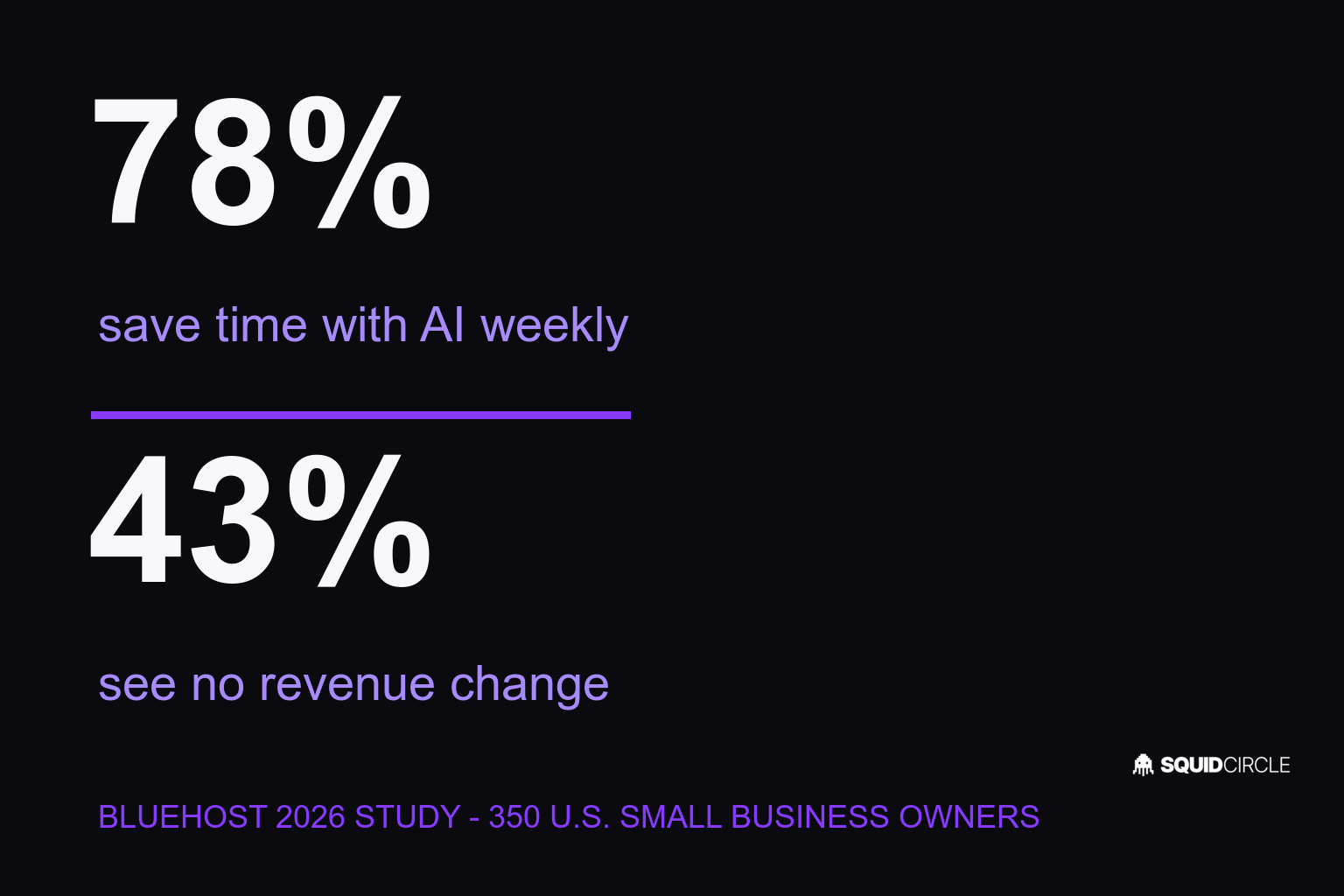
Here’s a number that should bother every small business owner using AI: 78% say AI saves them time every week. And 43% say it hasn’t moved their revenue at all.
Both numbers come from the same Bluehost 2026 study of 350 U.S. small business owners. The same owners. The same businesses. That’s not a contradiction — it’s the single most important lesson about AI in small business right now: saved time is not saved revenue unless you put it somewhere that pays.
Eric Groves, CEO of the small business network Alignable, put it bluntly in Fortune this month: Big Tech’s AI assistants “will save small business owners time. They won’t find them customers.” A general assistant can write your emails faster. It can’t answer the question that actually grows your business — because that answer lives in data it doesn’t have.
The Time Trap: Where Saved Hours Go to Die
You know the pattern. You use AI to draft social posts faster, so you post more. You use it to summarize your email, so your inbox hits zero. You save four hours a week — and then spend those four hours doing more of the same work that wasn’t generating revenue in the first place.
This lines up with what we found in the SBE Council’s 2026 survey: owners save a median of 5 hours a week with AI, employees save 11.5. That’s 16.5 hours per person, per week — a genuinely massive number. Two-thirds of businesses reported revenue gains, but that means a third saved all that time and made… nothing extra.
The difference between the two groups isn’t the AI they use. It’s where the saved time goes.
Time Only Counts When It Lands On Revenue
Here’s the test we use with our own workflows: for every hour AI saves you, that hour has to land on one of three things —
- Speed to lead — responding to inquiries before the competitor does
- Follow-up — the second, third, and fourth touch that most small businesses never send
- Capacity that’s billable — more appointments booked, more quotes out, more work delivered
If your saved hours aren’t hitting one of those, you’ve built a very efficient treadmill.
General Assistants Give You Time. Systems Give You Money.
Groves’s Fortune piece lays out the three forms AI reaches small businesses: the personal assistant (ChatGPT, Claude, Gemini — converging fast, great at time), the AI inside the systems that hold your data (Intuit knows your books, Shopify knows your store — great at control), and — the third form — AI that actually goes out and does the revenue work: answering the phone, booking the job, following up on the quote.
That third category is where the 43% find their way out. A faster content calendar doesn’t answer the phone at 6:40 PM when a customer calls. An email summarizer doesn’t chase the quote you sent last Tuesday. Time saved on busywork only converts when a system takes the revenue task off your plate entirely.
The One-Question Audit
Before your next AI subscription renews, ask this: “Which specific revenue action does this tool perform or enable?”
Not “what does it speed up?” — what does it do. If the answer is “it drafts things,” fine, but know that you’re buying time, not money, and it’s on you to reinvest that time. If the answer is “it answers every call and books the appointment,” you’ve bought money.
AI is genuinely, historically good at giving small teams big-company capability. But capability isn’t a result. Route the saved hours at lead response, follow-up, and bookable capacity — or accept that you’re just working faster for the same paycheck.
SquidBot does the third kind. It answers your leads, responds in seconds, follows up until someone books, and pushes everything into your calendar and CRM. That’s not saved time — that’s captured revenue. See how SquidBot works →