Goldman’s $500M AI Institute: Free SMB Training
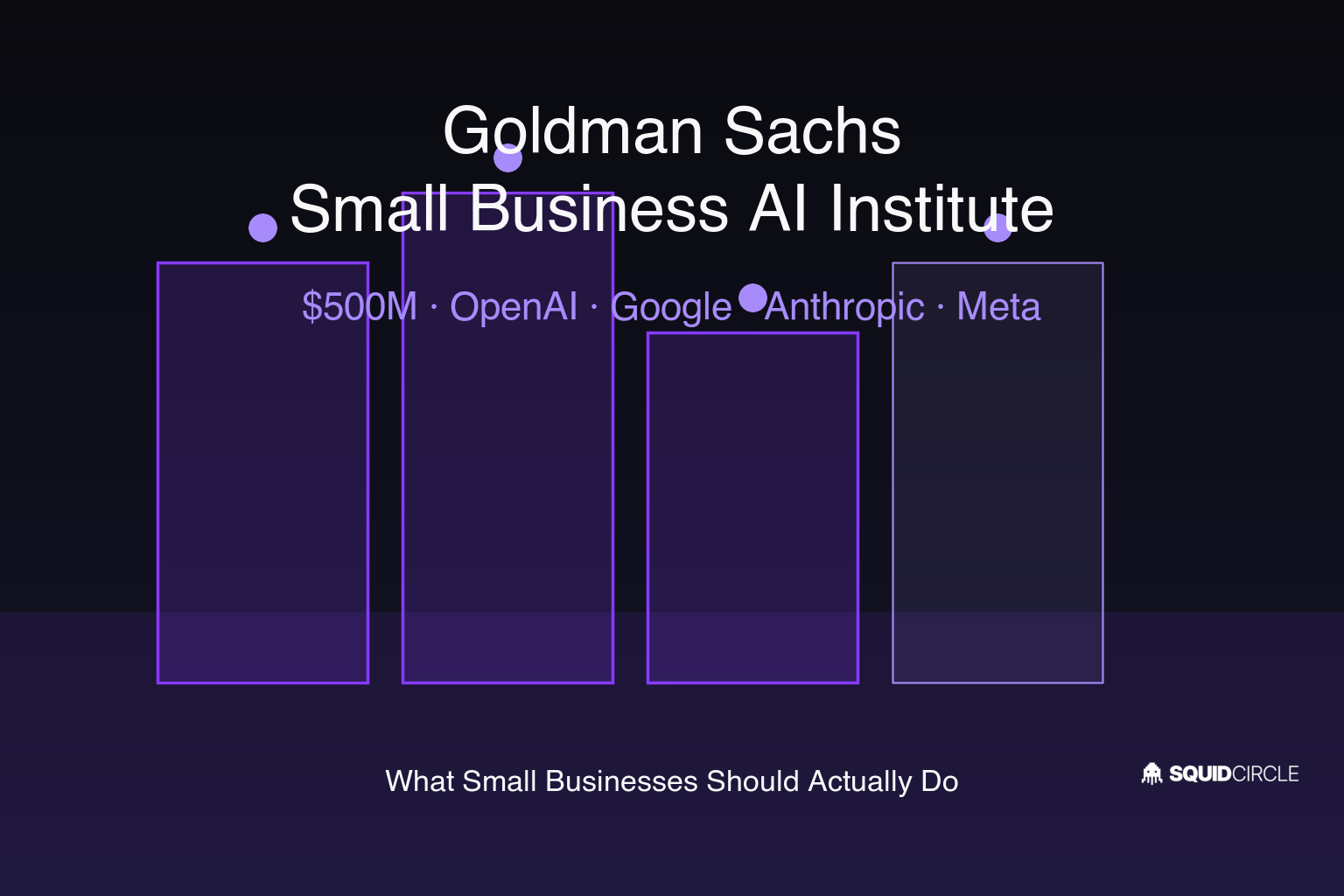
Yesterday, Goldman Sachs announced something small business owners should actually pay attention to: a $500 million commitment to expand its 10,000 Small Businesses program — and, more interestingly, the launch of the Goldman Sachs Small Business AI Institute, built in partnership with OpenAI, Google, Anthropic, and Meta.
If you run a small business, this isn’t just Wall Street philanthropy theater. It’s free AI training and tools from the four companies currently defining the technology, delivered through a program with a 16-year track record. Here’s what’s actually in it, and what to do about it.
What Goldman Announced
The details, from the October 22 announcement:
- $500 million to fund the next chapter of 10,000 Small Businesses — education, access to capital, and business support services for another 10,000 businesses.
- The Small Business AI Institute, partnering with Anthropic, Google, Meta, and OpenAI to provide AI training and tools to entrepreneurs across America.
- The Institute has three pillars: AI education for small business owners, research on how small businesses actually use AI, and AI-enabled expansions to access capital.
This stacks on top of the $1.25 billion Goldman has already committed to 10,000 Small Businesses since 2010. Nearly 20,000 entrepreneurs across all 50 states and four U.S. territories have completed the program. Goldman says graduates add jobs four times faster than similarly-sized businesses and together represent over $32 billion in annual revenue.
Sam Altman’s quote in the announcement is the tell: “We believe AI will create the greatest boom in entrepreneurship and small businesses that the world has ever seen.” The AI labs aren’t partnering with Goldman out of charity — they want Main Street adopting their tools, and they’re willing to train you on them for free.
The Stat That Matters: 15%
Buried in the announcement is the number that explains why this exists at all. Goldman surveyed more than 2,400 graduates of the program. Most of them use AI in some form. But only 15% have fully integrated it into their core operations. And over three-quarters said they need more training and resources to use AI effectively.
That gap — between “we dabble in AI” and “AI runs part of our business” — is exactly what we see in our own client work. A shop owner experiments with ChatGPT for email drafts, calls it a win, and stops there. Meanwhile the businesses pulling real value have AI answering leads, booking appointments, and following up automatically while they sleep.
The training gap is real. When Wall Street’s biggest bank and four AI labs collectively decide the bottleneck is education, that tells you where the market is headed next. Other survey data points the same direction — we recently covered new numbers showing 89% of small businesses say AI is finally paying off, but the payoff concentrates among those who integrated, not those who dabbled.
Why This Isn’t Just PR
Fair question: Goldman’s stock has roughly tripled in three years on the AI boom, it led the SpaceX IPO, and it’s reportedly working on the Anthropic IPO. The bank has skin in this game.
That doesn’t make the offer bad. It makes it aligned. Goldman profits when small businesses grow; the AI labs profit when small businesses adopt AI; you profit when you get trained on tools you’d otherwise have to figure out alone. When everyone’s incentives point the same direction, the free stuff tends to be genuinely useful.
The 10,000 Small Businesses program itself has a serious reputation — real coursework, real capital access, real alumni networks. Bolting an AI institute onto that infrastructure, with curriculum input from Anthropic, Google, Meta, and OpenAI, is worth more than the thousandth generic “intro to ChatGPT” webinar.
What Small Business Owners Should Do Now
1. Watch the application window. 10,000 Small Businesses has rolling applications and eligibility requirements (generally: a few years in operation, revenue thresholds, at least a couple of employees). If the AI Institute follows the same model, seats will be competitive. Check the program site and get your paperwork ready early.
2. Don’t wait for training to start. Free education arriving later this year is a nice tailwind, not a plan. The 85% of businesses that haven’t integrated AI don’t have a knowledge problem alone — they have a starting-point problem. Pick one workflow that eats hours every week: lead response, appointment booking, review requests, invoice chasing. Automate that one thing first. If you want a picture of where this goes, look at how always-on AI agents are already changing small business operations.
3. Use the capital angle. The third pillar — AI-enabled access to capital — is the sleeper item. Lenders are already using AI to assess small business credit in more nuanced ways. A program that combines AI literacy with capital access could matter more than the training itself for businesses looking to expand.
4. Budget your attention, not just money. Four AI labs in one curriculum means you’ll hear about Claude, Gemini, ChatGPT, and Meta’s AI tools. You don’t need all of them. You need one assistant your team actually uses daily, and one automation that touches revenue. That’s the honest starting stack for most small businesses.
The Bottom Line
Goldman Sachs just put $500 million behind the idea that AI adoption on Main Street is a training problem — and got OpenAI, Google, Anthropic, and Meta to co-sign it. The free training will be worth taking when it opens.
But the 15% number is the real message. The gap between using AI and integrating AI is where the next few years of competitive advantage live. The businesses that close it now — before the curriculum arrives — will be the case studies everyone else studies later.
If you want to start closing that gap today, SquidBot handles the integrating part for you: AI agents that respond to leads, book appointments, and run your follow-up automatically. You bring the business; the agents do the busywork.