89% of Small Businesses Say AI Is Finally Paying Off
For three years, small business owners have been told AI would “transform” their operations. Most of them tried a chatbot, saw mixed results, and filed the whole thing under “maybe later.” New survey data says “later” is over: adoption is climbing fast, and — more importantly — the people actually using AI say it’s paying off.
Here’s what the numbers actually say, and what we’d do with them if we were starting today.
The data, stripped of hype
Homebase — the scheduling and payroll platform used by 150,000+ small businesses — has been surveying the same population for two years. The shift in their numbers is stark:
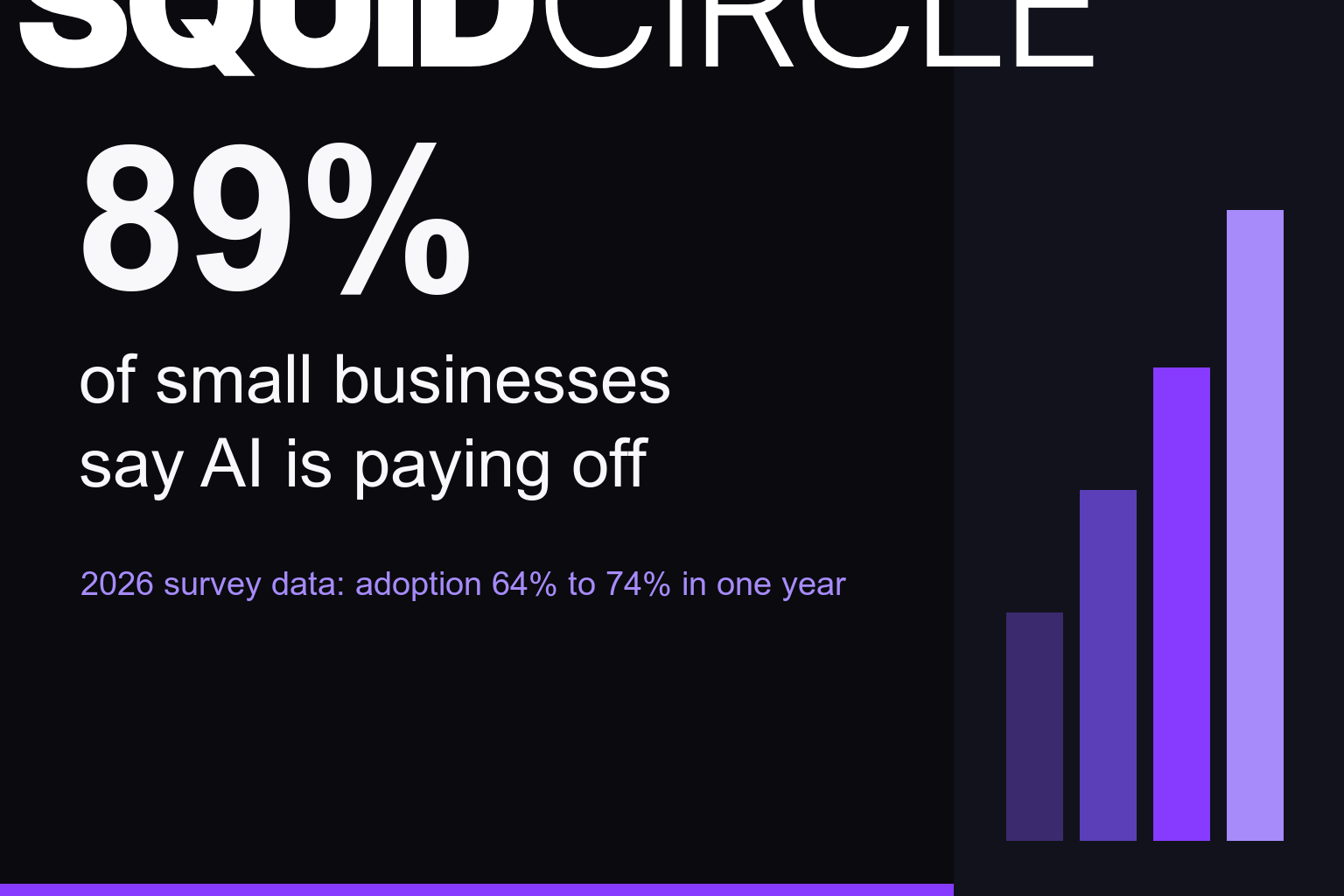
AI adoption jumped from about 64% of small businesses in 2025 to 74% in 2026 — a ten-point jump in a single year, among owners and managers of hourly-workforce businesses. These aren’t Silicon Valley startups. They’re restaurants, shops, salons, and contractors.
89% of businesses using AI now say it’s paying off — saving them real money and time. That’s the number that matters. Adoption stats tell you people are trying AI; payoff stats tell you they’re keeping it.
Small business leaders report saving roughly 6 to 10 hours a week with the tools they’ve deployed. For a five-person shop where the owner does everything, that’s a full workday handed back every week.
The pattern holds beyond one survey. OpenAI’s own analysis found at least four million Americans used ChatGPT in a single month just to plan, start, run, or grow a business — most of them consultants, online stores, home services, and restaurants, not tech companies.
Why this year is different
We’ve seen “AI adoption is up” headlines before. What changed in 2026 is what the adoption looks like.
The tools stopped being experiments. A year ago, a typical small business AI story was “we asked ChatGPT to write our Instagram captions.” Now it’s scheduled agents that triage the inbox, answer the phone, and chase reviews — things that run whether or not anyone remembers to prompt them. We’ve written about this shift directly: AI email triage alone is saving small teams 10+ hours a week.
The models got cheap enough to leave running. The price of capable AI dropped so far this year that “always-on” automation now costs less than the hours it saves. That flips the math for a business where the owner’s time is the scarcest resource.
Reliability crossed the “good enough” line. Last year’s voice agents misheard and hallucinated. This year’s handle bookings and FAQs without a human babysitting them. The 2026 AI receptionist numbers tell the same story: the technology stopped being a demo.
The part of the survey nobody headlines
Not everyone is on board. Roughly one in ten small businesses still wants nothing to do with AI, and a meaningful slice of “adopters” are using it for internal drafting only — not customer-facing work.
That gap is the real story. The 89% who say AI is paying off aren’t smarter or better-funded. They mostly did one thing differently: they pointed AI at a specific, recurring, measurable task — missed calls, inbox triage, review requests — instead of trying to “use AI” in general.
The businesses struggling to see ROI are usually the ones treating AI as a strategy instead of a tool. Strategy is vague. Tools either save hours this month or they don’t.
What to do with this
If you’re in the 26% not using AI yet, ignore the FOMO framing and ask one question: what recurring task eats your week and follows predictable rules? Answering the same customer questions. Rescheduling the same appointments. Chasing the same reviews. That’s your first automation — and at 6–10 hours/week of reclaimed time, most pay for themselves inside a month.
If you’ve already dipped a toe in and didn’t feel the payoff, audit whether you deployed a tool or a habit. One-off prompting saves minutes. Deployed agents save hours. The survey data is clear about which group reports the 89%.
The bottom line
The “is AI worth it for small business?” debate is effectively settled among the people who’ve actually run it. Adoption is up ten points, nearly nine in ten users report real returns, and the hours saved are no longer theoretical.
The competitive gap is shifting from “who uses AI” to “who’s had it running longest” — and that’s a gap that only compounds. If you want to be on the right side of it, SquidBot builds and runs AI agents for small businesses — receptionists, inbox triage, and follow-up — on the models that exist today, with humans in the loop.