We Turn One Client Call Into a Week of AI Content
Every small business owner has been there. You wrap up a great client call — the kind where ideas flow, problems get solved, and your customer says something genuinely insightful — and then nothing happens. The recording sits in a folder. The notes stay unread. The momentum dies.
We used to do the same thing. Then we built a pipeline that turns every client conversation into a week of content automatically. Not “AI wrote a generic blog post” content — actual, useful, implementation-grounded content that sounds like us because it comes from us.
Here’s exactly how it works.
The Problem: Great Calls, Zero Output
A typical client call lasts 30 to 60 minutes. In that window, you’ll hear pain points, industry trends, specific questions, and offhand comments that would make excellent content. But by the time the call ends, you’re on to the next task. The transcript exists, but nobody has time to mine it.
We were sitting on hours of recordings and getting zero content from them. Meanwhile, we were spending separate hours staring at blank pages trying to come up with blog topics and social posts. The disconnect was embarrassing.
What We Built: A 5-Stage Content Pipeline
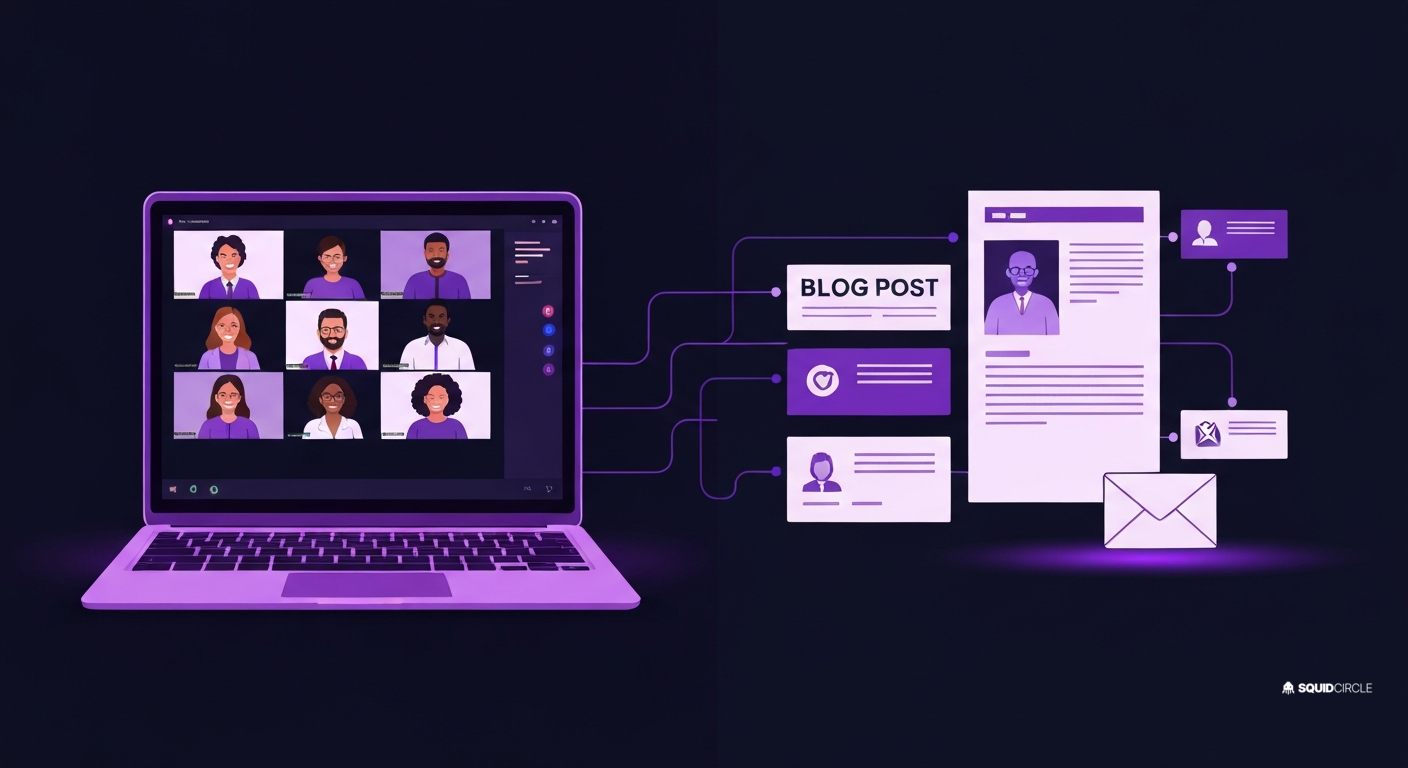
We connected five AI agents into a single pipeline. One call goes in. Five pieces of content come out.
Stage 1: Capture and Transcribe
Every client call gets recorded (with consent). The audio goes through a transcription model that outputs a clean, speaker-labeled transcript. No manual cleanup needed — the model handles filler words, crosstalk, and technical jargon.
The transcript becomes the raw material for everything downstream. One call typically yields 4,000 to 8,000 words of transcript. That’s enough raw material for a week of content.
Stage 2: Insight Extraction
This is where most content pipelines fail. They skip straight to “write me a blog post” and end up with generic fluff. We added an extraction step that pulls specific, useful elements from the transcript:
- Pain points — what problems did the client describe?
- Specific questions — what did they ask that others probably ask too?
- Memorable quotes — did anyone say something worth highlighting?
- Action items — what was decided or promised?
- Industry trends — did the conversation touch on broader patterns?
The extraction agent outputs a structured summary. This is the gold — it’s where the authentic, specific, human content comes from.
Stage 3: Blog Post Draft
From the extracted insights, our content agent drafts a full blog post. Not a listicle. Not a generic “AI is changing everything” piece. A specific, implementation-grounded article built around what actually came up in the call.
If the client mentioned a specific workflow problem, the post addresses that problem. If they asked about AI tools, the post covers what we recommended. The content is inherently unique because it came from a real conversation.
The draft still needs human review — about 15 minutes of editing to add voice, cut sections that are too client-specific, and tighten the narrative. But that’s 15 minutes instead of 3 hours.
Stage 4: Social Posts
From the same insight extraction, a second agent generates social media posts:
- LinkedIn — a 150-word thought leadership post pulled from the most interesting insight in the call
- Twitter/X — 3 to 5 tweets, each highlighting a different point or statistic
- Instagram — a caption that works as a quick tip or takeaway
Each post references the blog article with a link. One call produces enough social content for a full week of posting across three platforms.
Stage 5: Email Campaign
The final stage turns the most valuable insight from the call into an email. Not a “we just published a blog post” notification — a standalone email that delivers value on its own, with a soft link to the full article.
This is the same insight that became the blog post and social content, but reformatted for email readers. The subject line comes from the client’s own words, pulled directly from the transcript. Open rates on these emails consistently beat our generic campaigns because the subject lines sound like real conversations.
The Real Numbers
Before this pipeline, we published one blog post per week. Each one took 2 to 3 hours of writing from scratch, plus research. Social posts were an afterthought, usually thrown together in 15 minutes.
After the pipeline:
- 3 blog posts per week (up from 1)
- 15 social posts per week (up from 5)
- 2 email campaigns per week (up from 1)
- 15 minutes of human editing per post (down from 3 hours of writing)
The quality went up, not down, because every piece starts from a real conversation instead of a blank page. The AI handles the structural work — drafting, formatting, repurposing across formats — while the human handles the editorial judgment.
Why This Works Better Than “Just Use ChatGPT”
You could paste a transcript into ChatGPT and ask for a blog post. We tried that. Here’s what happened:
The output was generic. It smoothed out every sharp edge, removed every specific detail, and produced content that could have been about any business in any industry. It was technically correct and completely forgettable.
The pipeline works because each stage has a specific job. The extraction agent doesn’t write — it just pulls signal from noise. The blog agent doesn’t extract — it just writes. The social agent adapts for each platform. Each step is simple. Chained together, they produce something none of them could produce alone.
This is also why we stopped treating CRM cleanup and content creation as separate problems. Every client interaction is a data source. Every data source can become content. The pipeline connects them.
How to Steal This Workflow
You don’t need our exact setup to do this. Here’s the minimum viable version:
Step 1: Record your next 3 client calls (with permission). Get them transcribed — there are dozens of tools that do this for under $1 per hour of audio.
Step 2: Read each transcript and highlight: one pain point, one question, one quote, and one action item. That’s your content brief.
Step 3: Feed the brief into an AI model with this prompt: “Write a 600-word blog post about [pain point] for [your audience]. Use this quote from a real conversation: [quote]. Reference this specific question we received: [question].”
Step 4: Take the same brief and ask for 3 LinkedIn posts, 5 tweets, and one email subject line + opening paragraph.
Step 5: Spend 15 minutes editing each output. Cut anything generic. Keep anything that sounds like a real person said it — because a real person did.
Total time: 30 minutes per call, including editing. Output: one blog post, five social posts, and one email campaign. That’s a 10x improvement over writing from scratch.
What We’re Doing Next
The current pipeline runs on our agent platform — one trigger starts the whole chain. The next version will connect directly to our lead follow-up system, so every new lead conversation automatically feeds into the content pipeline.
The goal: never start a piece of content from a blank page again. Every blog post, every email, every social update should trace back to a real conversation with a real human. Because that’s what makes content worth reading.
If you want to see how this works in practice, we’re building it into SquidBot. Book a call and you’ll see the pipeline in action — because your call might just become next week’s content.