AI Is Now Building Itself: What Anthropic’s RSI Report Means for Your Business
This week, Anthropic — the company behind Claude, one of the world’s most powerful AI systems — published a report that quietly changed how we should think about the future of artificial intelligence. It’s called “When AI builds itself,” and if you run a business of any size, you need to understand what it says.
Here’s the short version: AI is no longer just a tool that humans use. It’s becoming a tool that builds itself.
And it’s happening much faster than anyone expected.
The Number That Should Stop You in Your Tracks
In May 2026, more than 80% of all production code shipped at Anthropic was written by Claude — their own AI. Not tweaked by AI. Not reviewed by AI. Written by Claude, from scratch.
That’s up from “low single digits” before Claude Code launched in February 2025. In barely a year, the company went from humans writing almost everything to AI writing the vast majority of it.
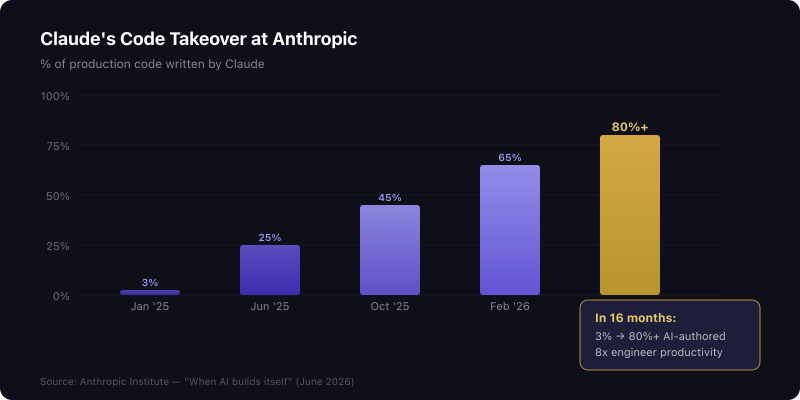
And this isn’t throwaway code. Anthropic’s engineers are now shipping 8 times as much code per day compared to 2024. The quality has gone from “worse than human” to “roughly at parity” — and Anthropic expects it to surpass human quality within the year.
What Is “Recursive Self-Improvement”?
Anthropic defines it plainly: “an AI system capable of fully autonomously designing and developing its own successor.”
The idea has been debated in AI research circles for years. The concept is simple but profound: what happens when an AI gets good enough to build a smarter version of itself? And then that version builds an even smarter one? And so on?
Anthropic’s answer: we’re not there yet, but “it could come sooner than most institutions are prepared for.”
Here’s why that statement carries weight: the data they’re publishing from inside their own company suggests the acceleration is real and measurable.
The Speed of the Shift
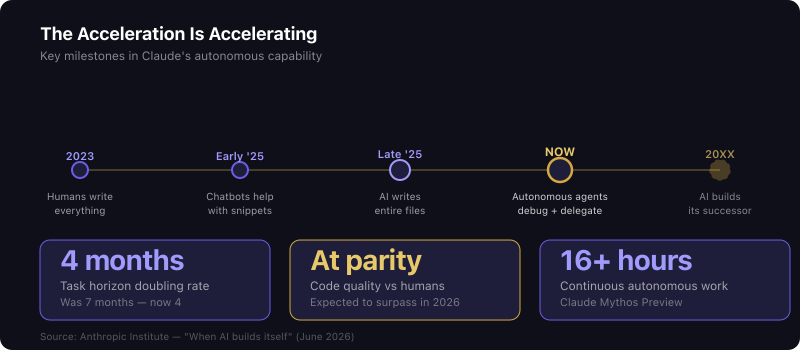
The time horizons for what AI can complete on its own are doubling every 4 months — and that pace is itself accelerating. It used to double every 7 months.
Claude’s success rate on open-ended tasks hit 76% in May 2026 — a 50-point jump in just six months. And in a research benchmark, Claude agents recovered 97% of a performance gap, compared to just 23% by two skilled human researchers working for a full week.
Or consider this: Claude’s code optimization capability went from a 3x speedup in May 2025 to a 52x speedup by April 2026. A skilled human engineer typically needs 4 to 8 hours to achieve a 4x speedup. Claude now blows past that in minutes.
The latest version, Claude Mythos Preview, can work continuously for 16+ hours without human intervention.
The Humans in the Loop
Here’s the part that surprised me most. Anthropic included candid quotes from their own engineers, and they’re remarkably honest:
“I started leaning hard into Claudifying about a year ago… it’s now been ~5 months since I last wrote any code myself.”
“Work ran on a gift economy of small favors between humans… Claude has eaten the favors.”
And perhaps the most haunting one:
“On days where everything works well, I can’t help but think nothing I do matters…”
But before you picture a dystopia, there’s a critical nuance:
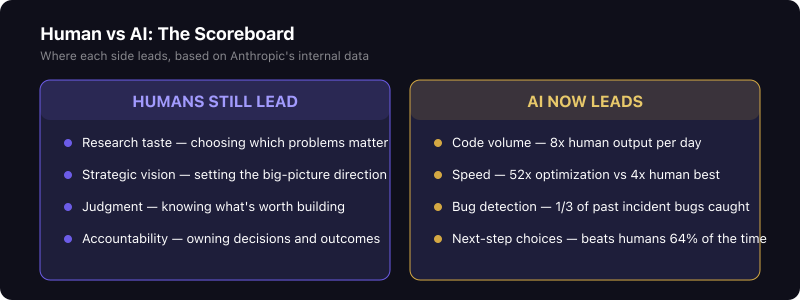
Humans still lead where it matters most: research taste, judgment, choosing the right problems to solve, and holding the big-picture strategic vision. Claude beats humans on picking the right next step 64% of the time (up from 51%), but humans still set the direction.
Think of it like this: the AI is becoming the most capable worker you’ve ever had. But it still needs a manager who knows what needs doing.
This Isn’t Just Anthropic
The same week Anthropic published their report, OpenAI released a blueprint for “Democratic Governance of Frontier AI,” acknowledging “early signs of recursive self-improvement.” Meanwhile, MiniMax — an AI lab in Shanghai — claims their M2.7 model has achieved 30% self-improvement through recursive self-optimization.
This is a global shift, not one company’s achievement. Anthropic explicitly said they would slow down or pause frontier AI development if peer labs agreed to do the same. So far, no one’s volunteering.
Benchmark after benchmark is falling. SWE-bench — a major test of software engineering ability — went from challenging to saturated in just 2 years. Its harder successor, CORE-Bench, went from 20% to saturated in only 15 months.
What This Means for Your Business
You might be thinking, “That’s interesting, but I’m not a tech company.” Here’s why this matters for every business:
1. AI agents are about to get dramatically more capable. The systems being built right now are the foundation for the AI assistants, chatbots, and automation tools you’ll be using in 6 to 12 months. What seems cutting-edge today will feel basic by Christmas.
2. The cost of automation is plummeting. When AI can write and optimize its own code, the cost of building custom automation drops to near-zero. Tasks that would have required a $50K software project will soon be handled by an AI agent in an afternoon.
3. Your competitive advantage is how fast you adopt. As we wrote recently when AI agents went mainstream across Microsoft, OpenAI, and others, the businesses that win won’t be the ones with the best AI — they’ll be the ones that figure out how to use it first.
4. “AI strategy” is becoming just “strategy.” When AI can handle 80%+ of knowledge work, every business decision becomes an AI decision. The question isn’t whether to use AI — it’s how to use it well.
5. Humans aren’t obsolete — they’re more important than ever. The Anthropic engineers said it best: AI is incredible at execution, but humans still own the vision. The premium skill isn’t coding or crunching numbers. It’s knowing what to build and why.
The Bottom Line
Anthropic’s report isn’t a prediction. It’s a status update from the front lines. The AI systems of today are already building the AI systems of tomorrow. The loop is closing.
For small business owners, this is both the biggest opportunity and the biggest wake-up call of 2026. The tools that will transform how you operate are being built right now — quite literally, by the previous version of themselves.
The question isn’t whether this changes everything. It’s whether you’ll be ready when it does.
Want to stay ahead of what’s coming? Follow SquidCircle for weekly breakdowns of the AI developments that matter most for your business.
Source: Anthropic Institute — “When AI builds itself” (June 2026)