AI Review and Content Loop: Turn Customer Feedback Into a Growth Engine
Most small-business owners know they need two things to grow: a steady stream of online reviews and fresh content that shows up in search results. The problem? Both feel like full-time jobs nobody on your team has time for.
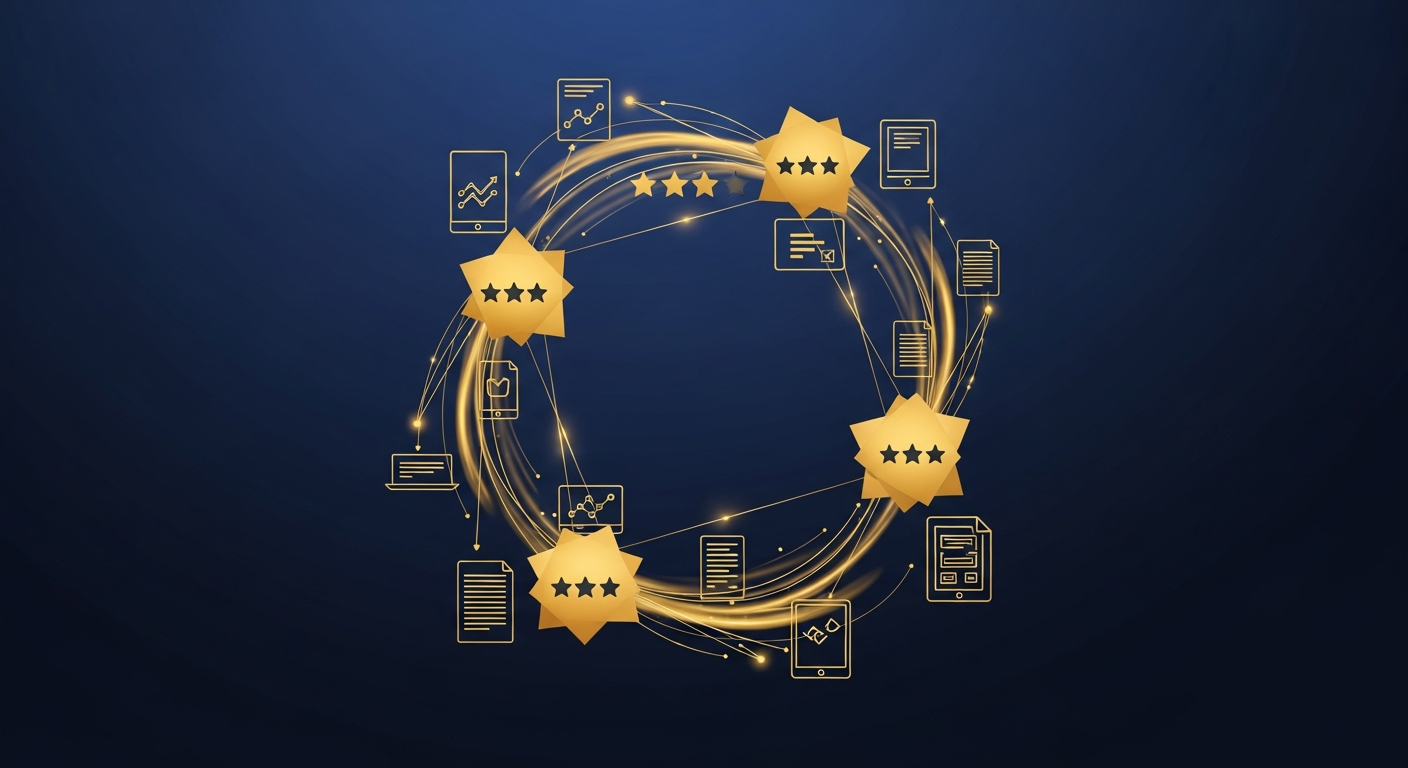
Here’s the good news: AI agents can now handle both — not as separate chores, but as a connected growth loop. Your AI collects reviews after every job, turns those reviews into blog posts and social content, and feeds everything back into your local SEO ranking. It runs while you sleep, and it costs a fraction of hiring a marketing agency.
In this guide, I’ll walk through exactly how this loop works, what it looks like in practice, and how you can set it up for your own business — whether you run a dental practice, a landscaping company, or a boutique consulting firm.
Quick Summary
- Online reviews and content are the two biggest drivers of local search visibility for small businesses.
- AI agents can automatically request reviews after service, generate content from customer feedback, and distribute everything across platforms.
- The review-to-content loop compounds over time — more reviews lead to more content, which attracts more customers, who leave more reviews.
- Implementation takes hours, not months, with the right AI agent framework.
- Common mistakes include sending generic review requests, ignoring negative feedback, and publishing thin content that doesn’t help readers.
Why Reviews and Content Are Your Growth Engine
Let’s start with the numbers. Businesses with more than 50 Google reviews earn 282% more revenue than businesses with fewer reviews, according to BrightLocal’s annual survey. Meanwhile, companies that publish 16+ blog posts per month get 3.5 times more traffic than those publishing fewer than four, per HubSpot research.
These aren’t separate strategies — they’re connected. Reviews build trust and improve your Google Business Profile ranking. Content builds authority and pulls in organic search traffic. Together, they create a flywheel that feeds itself.
But here’s where most owner-operated businesses get stuck: they have time to do the work, not market the work. That’s where AI agents change the game.
How the AI Review-to-Content Loop Works
Think of this as a three-stage cycle that runs on autopilot:
Stage 1: Automatic Review Collection
After every completed job or appointment, your AI agent sends a personalized follow-up message to the customer. The message references the specific service they received, includes a direct link to your Google Business Profile review page, and times the send for maximum response rates (typically 2-4 hours after service completion).
This isn’t a generic “Thanks for your business, please review us” blast. The AI personalizes each message based on the service type, the customer’s history, and even the time of day. A landscaping client who just got their first spring cleanup gets a different message than a recurring lawn-care customer.
Stage 2: Content Generation from Reviews
Here’s where the magic happens. Your AI agent monitors incoming reviews and uses them as raw material for content creation:
- Positive reviews become case studies, social media posts, and blog content highlighting real results.
- Common themes across multiple reviews become FAQ pages and educational blog posts.
- Specific details (project scope, timeline, results) become the backbone of service-specific landing pages.
For example, if five customers mention how fast your team completed their bathroom renovation, the AI generates a blog post titled something like “Why Our Bathroom Renovations Take Half the Time” — with real customer quotes (with permission) and practical details about your process.
Stage 3: Distribution and SEO Amplification
Once content is generated, your connected AI agents handle distribution:
- Blog posts go live on your website with optimized SEO metadata.
- Social excerpts post to Facebook, Instagram, and LinkedIn.
- Google Business Profile updates highlight new reviews and content.
- Email digests showcase recent projects and customer stories.
Each piece of content links back to your review profiles, creating a reinforcing cycle of visibility and trust.
Real-World Example: A Dental Practice
Let’s say you run a dental practice doing $3M in annual revenue. Here’s what the loop looks like in practice:
- Monday: Patient completes a routine cleaning. AI agent sends a personalized follow-up via SMS two hours later with a Google review link.
- Tuesday: Patient leaves a 5-star review mentioning “no wait time” and “gentle cleaning technique.” AI agent detects the review and drafts a short blog post about your practice’s approach to comfortable, efficient dental care.
- Wednesday: After your approval (or automatically, if configured), the blog post goes live. An AI follow-up agent creates social media versions for Facebook and Instagram.
- Ongoing: Over a month, 40+ reviews and 8+ blog posts compound. Your Google Business Profile ranking climbs. Your website traffic grows. New patients find you through search instead of paid ads.
The key insight: none of this requires you to sit down and write anything. Your AI review and referral agent handles the entire workflow from solicitation to publication.
Implementation Steps: Setting Up Your Own Loop
Here’s how to get this running for your business, broken into actionable steps:
Step 1: Connect Your Review Channels
Link your Google Business Profile, Facebook Page, and any industry-specific review sites (Yelp, Healthgrades, Angi) to your AI agent platform. The agent needs access to monitor incoming reviews and track response rates.
Step 2: Set Up Automated Review Requests
Configure your AI agent to send review requests after specific triggers: completed appointments, project milestones, or invoice payments. Personalize the message templates by service type. Most businesses see a 15-25% review response rate with personalized AI outreach versus 3-5% with generic requests.
Step 3: Create Content Rules
Define what kinds of content the AI should generate from reviews. Good starting rules include:
- If 3+ reviews mention the same positive attribute within 30 days, generate a blog post about it.
- Every 5-star review with 50+ words becomes a social media highlight.
- Negative reviews trigger an internal alert for human follow-up (never auto-respond to negative reviews).
Step 4: Set Editorial Guardrails
Decide whether content publishes automatically or requires your approval first. For most businesses, a hybrid approach works best: social media content auto-publishes, blog posts go through a quick review queue, and all content involving customer quotes requires explicit consent.
Step 5: Monitor and Iterate
Track review velocity (new reviews per week), content output (posts per month), and organic traffic growth. Adjust your AI agent’s settings monthly based on what’s working. AI agents improve over time as they learn your brand voice and customer patterns.
Common Mistakes to Avoid
1. Sending the Same Review Request to Everyone
Generic messages get ignored. Your AI should reference the specific service, use the customer’s name, and vary the tone based on the relationship. A first-time customer needs a different approach than someone who’s been with you for three years.
2. Ignoring Negative Reviews
AI can surface negative feedback instantly, but the response should come from a human. Set up alerts so your AI notifies you immediately when a review below 3 stars comes in, and have a real person respond within 24 hours. This shows prospective customers you care.
3. Publishing Thin Content
Don’t let your AI pump out 300-word posts that add no value. Every piece of content should solve a real question your customers have, include specific examples, and provide actionable takeaways. Quality compounds faster than quantity.
4. Forgetting to Ask for Permission
If you want to use a customer’s words in your marketing content, ask first. Your AI agent can automate permission requests — sending a quick “Can we feature your feedback on our website?” message when a great review comes in.
5. Measuring the Wrong Things
Don’t just track review count. Track review velocity (how fast they’re coming in), average rating trend, response rate to your requests, and — most importantly — how many new customers mention finding you through reviews or search.
The Compound Effect: What Happens After 90 Days
Here’s what a typical service business sees after running this loop for three months:
- Week 1-2: Review velocity increases from 2-3/month to 15-20/month with automated requests.
- Week 3-4: First batch of review-driven content goes live. Social media posting frequency doubles.
- Week 5-8: Google Business Profile ranking improves for key local search terms. Website traffic starts climbing.
- Week 9-12: The flywheel is spinning. New customers are finding you through organic search. Your review profile looks impressive compared to competitors. Content library has 12-15 high-quality posts.
Businesses using AI agents for home service businesses report similar timelines — the first month is setup, the second month shows early results, and by month three the growth is self-sustaining.
Sources
- BrightLocal — Local Consumer Review Survey 2025
- HubSpot — Blogging Frequency and Traffic Benchmarks
- Forbes — Why AI Is the Future of Small Business Customer Engagement
Frequently Asked Questions
How many reviews do I need before I see a real SEO impact?
Most local SEO experts agree that 25-50 Google reviews is the tipping point where you start seeing measurable ranking improvements. The key is consistency — getting 5-10 new reviews per month signals to Google that your business is active and trusted. AI automation makes this consistency achievable without manual effort.
Can AI agents handle review responses for me?
AI can draft responses to positive and neutral reviews, which you can review and approve before sending. For negative reviews, always have a human respond — customers can tell when a generic AI response doesn’t address their specific concern, and it often makes the situation worse.
What if I don’t have enough reviews yet to generate content?
Start with the reviews you have, even if it’s just a handful. Each detailed review can become multiple pieces of content: a social post, a FAQ answer, and a section of a blog post. As your AI agent collects more reviews through automated requests, your content library grows naturally.
Is this approach compliant with Google’s review policies?
Yes, as long as you don’t incentivize reviews (offering discounts or freebies in exchange for positive reviews). Asking customers to share their honest experience is perfectly fine and encouraged by Google. Your AI agent should never pre-screen customers based on whether you think they’ll leave a positive review.
How much does it cost to set up an AI review-to-content loop?
Platforms like SquidBot include this as part of a full AI agent suite, starting with a one-time setup fee and a monthly membership. Compared to hiring a marketing agency ($2,000-5,000/month) or a part-time social media manager ($1,500-2,500/month), AI agents deliver similar results at a fraction of the cost — and they work 24/7.
Conclusion: Your Reviews Are Untapped Marketing Gold
Every happy customer who doesn’t leave a review is a missed marketing opportunity. Every review that sits unread on your Google profile without becoming content is wasted potential. AI agents close both of those gaps — automatically collecting the feedback your customers are already happy to give, and turning it into the content that helps new customers find you.
The businesses that figure this out first won’t just have more reviews or better content. They’ll have a growth engine that compounds month after month, attracting customers through organic search while their competitors keep paying for ads.
Ready to turn your reviews into a growth engine? SquidCircle‘s AI agents handle review collection, content generation, and multi-platform distribution — all trained on your specific business. Book a free consultation to see how it works for your industry.